How street portraiture can improve your photography – and your confidence
- Jade Burrell
- Mar 28, 2025
- 6 min read
Updated: Jul 27, 2025
The Photography Show is a place to connect, experiment, and hone your skills – but what if the thing holding you back isn’t technical ability, but fear?
Street portraiture always seemed like a skill reserved for those who could strike up conversations effortlessly - the photographers who walk through crowds, camera in hand, capturing striking images without hesitation. They seem entirely at ease, taking the shot and moving on without a second thought. I, however, am not one of those people.
I’m used to the comfort of self-portraits, where I don’t have to engage with anyone, controlling the entire situation. But photographing strangers – actually approaching them and asking for a photo – was a whole different challenge. I’m not exactly great at striking up conversations with people I don’t know, and the idea of doing so in a public space felt downright intimidating. But, as any photographer (or journalist) will tell you, real growth happens outside of the comfort zone.
The Photography Show
During The Photography Show 2025, I set myself a challenge for when I got home: to step out of my comfort zone and photograph strangers on the street. No carefully arranged shoots, no familiar faces – just a camera, my instincts, and the uncertainty of approaching people I’d never met before.
For the first time, The Photography Show took place at ExCeL London, drawing photographers of all levels to explore the latest gear, attend workshops, and connect with industry experts. While there, I met Hazel Soper, the event’s organiser, who reinforced the sense of community that defines the industry.
“It’s a small industry… Everyone’s approachable here. And if you say, ‘My focus is street photography and approaching strangers,’ there’s going to be someone in there who’ll be overjoyed to help you with that,” she told me. It was reassuring to hear; maybe I wasn’t as alone in this struggle as I thought.
I love photography and portraiture, but let’s be honest – I’m not the best at striking up conversations with strangers. So, naturally, the next step seemed to be photographing those very strangers.
Confidence and street photography
"I still get nervous asking people. It's something I don't think I'll get over.” - Niall McDiarmid
Along the way, I spoke with street photographers like Niall McDiarmid to learn their techniques, confront my fears of rejection, and figure out what works (and what doesn’t) when approaching people in public.
“The thing that helps me most,” Niall says, “is the ability to explain clearly to people what I am looking to do. Most people understand then. They can either say yes or no. If they say yes – great. I just do three or four shots and move on. If they say no, I just say thanks and move on.”
He also shared a crucial piece of advice: don't stress about making people feel perfectly at ease in front of the camera.
“Often the best portraits come from people who look a little awkward, and vice versa - the worst portraits are often from people who pose too much.”
That might just be my favourite takeaway. The awkwardness, in a way, is the photo.
His biggest tip, though? Keep shooting. Don’t stop. Confidence will come with practice, even if it takes years.
“Even though I've been stopping people in the street to make portraits for many years,” he adds, “I still get nervous asking people. It's something I don't think I'll get over.”
It’s comforting to know that even seasoned photographers like Niall still experience that nervous energy when approaching strangers. It’s a reminder that confidence comes with time and persistence – and that the vulnerability of being nervous is part of the process.
And you know what? I’m just going to have to trust that process. I could easily stay at home, binge-watching Netflix like usual. But this? This is an opportunity to face my fears and take some photos.
The experiment
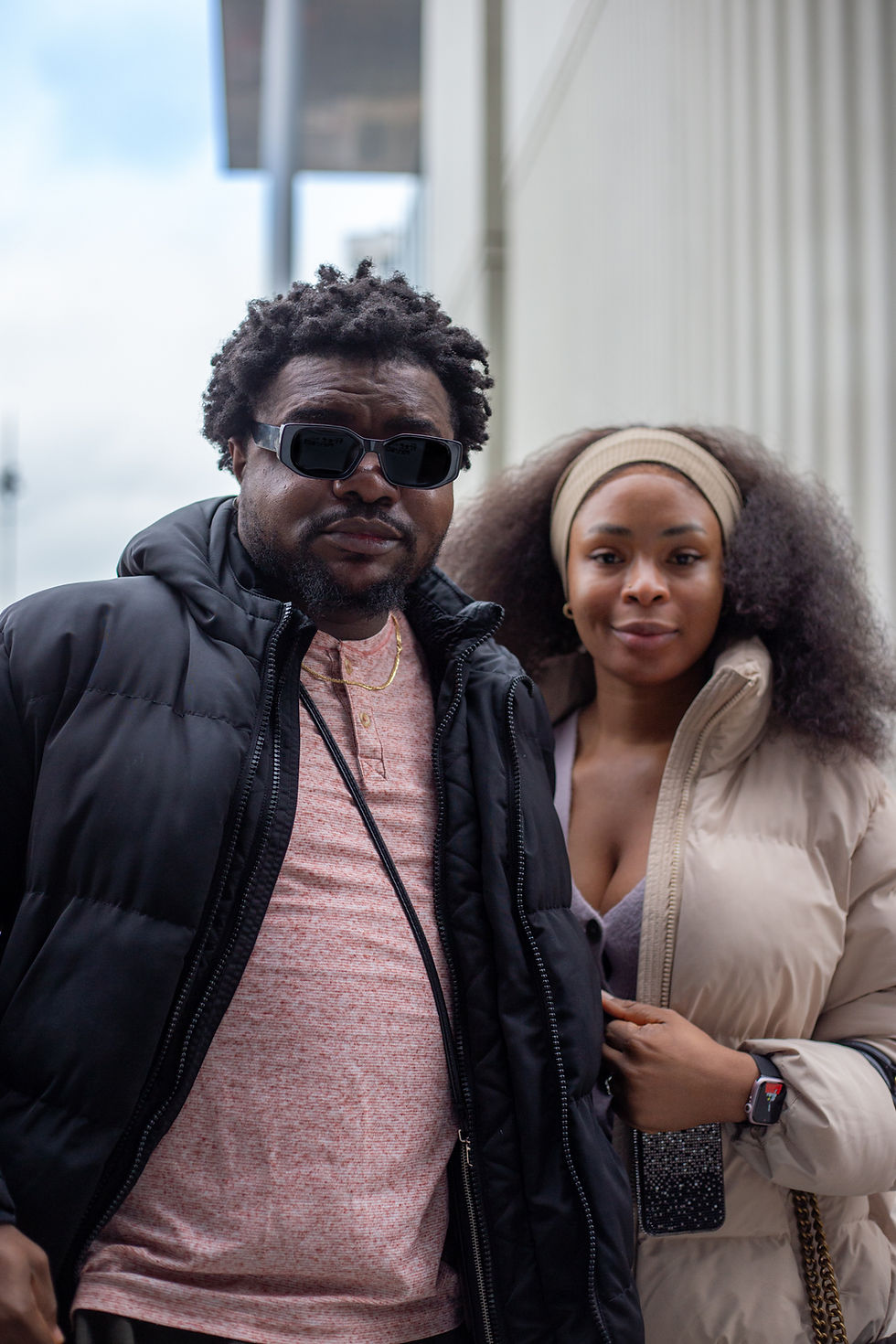
So, I stomp through Cardiff, camera in hand, convincing myself that approaching strangers for a photo isn’t weird. It’s normal. Totally normal. Like breathing. Or having a favourite burner on the stove (it’s the front left one).
I’ve also been promising myself a sweet treat if I get at least ten photos because a little psychological bribery never hurt anyone, right?
It’s been a while since I’ve done any proper photography. Self-portraits? Sure. But actual portraits? Not so much. My last shoot was back in June at the Wales and West Photography Show. Since then, my Instagram has been pretty much a dog-in-a-Christmas-jumper kind of vibe. So I’m rusty, to say the least.
Now I’m not just worrying about going up to people and asking for their photo, I’m also worrying about actually taking a good one. What if I spend too long fumbling with my settings? What if I’m too awkward to direct them? What if I completely bottle it?
But then again, what would I have to write about if I didn’t push myself to try?

In an attempt to convince myself that this whole thing wasn’t as terrifying as it seemed, I borrowed a whiteboard, scrawled “FREE PHOTO PORTRAITS” across it, and planted myself outside Cardiff Central train station.
The logic? Simple: act like a professional, and someone would surely stop. Or, at the very least, if it all went terribly wrong, I’d have a dramatic run-in with security to spice up the story.
So, there I was, sitting with my sign, just me and the pigeons – who, frankly, seemed to be judging every decision I’d ever made.
People glanced at me and kept walking. Others avoided eye contact altogether, which was fair – I’d probably do the same.
Eventually, someone stopped. A man in a black coat glanced at my sign, nodded, and said, “Yeah, why not?”

I didn’t have time to panic. I just grabbed my camera and started shooting.
That first success was a small victory, but it made a world of difference. It didn’t make the process easy, but the fear began to loosen its grip. With each “yes,” my confidence grew. And with each “no,” I learned not to take it personally – it was just part of the process.
Some people were happy to chat, and curious about the project. Others barely spoke, but still let me take their photo.
People are generally kinder than we give them credit for and it's important to remember sometimes people just don't like having their photo taken. It's nothing personal against me when people quickly scurried away before I had a chance to say hi.
A few days later, I tried again in the South Wales beach town of Porthcawl, this time without the sign. I figured maybe I was using it as a crutch, that I should be able to just approach people and ask. Without it, I just got more anxious. Every time I spotted someone I wanted to photograph, I'd start marching up to them, all the confidence in the world and then just as confidently walk straight past them.

In the short walk, I’d start to doubt myself, overthink it, and eventually talk myself out of it. That said, I did manage to get a couple of photos of people in Porthcawl. More often than not, they were more than happy to help. No one seemed to find me weird at all. Instead, they’d think it was an interesting concept, tell me to go for it, and even wish me luck. It was the kind of reassurance I needed - proof that people weren’t as scary as my brain was making them out to be.
It really was just all in my head.
The whole thing reminded me of Sophie Jones, a TikToker who has a series called Rejection Therapy, where she goes out in public and asks people questions she knows will probably get a "no" or make her seem weird.
At the end of her Day One video, she says, "It wasn’t even that bad and that’s the whole point of doing this - proving to your mind that things aren’t as bad as you think. Your brain just plays tricks on you and you can do whatever you want."In a lot of her videos, she also explains that people might think you're weird or crazy, but it doesn’t matter. You don’t know them. They don’t know you. They'll forget all about it in five minutes.
That was exactly what I needed to hear. Because, really, what was the worst that could happen? Someone says no? Does someone think I’m odd? So what?

By the end of the challenge, I’d come to accept a few things. First: the fear never fully goes away. I’d psych myself up, and march toward someone with all the confidence in the world - only to panic at the last second and walk straight past them. The anxiety never really left; I just got better at pushing through it.
But here’s the thing: I got some good photos. I spoke to people. And while rejection stung – whether it was a polite “no, thanks” or a baffled look as if I’d just asked to borrow their – I realised it was never personal. People just didn’t want their picture taken, and that was fair enough.
In the end, the experience was more than just a photography exercise; it was a lesson in resilience. It forced me to slow down, to engage with people in a way that felt raw and real.
And while I’m still far from striding through the streets like some portrait-taking machine, I know one thing for sure – I want to do this again. Because sometimes, the best photos aren’t just about the shot. They’re about the moment, the connection, and the courage it takes to ask for it.
Comments