The architect who taught buildings to move
- Jade Burrell

- Feb 5
- 8 min read
Frank Gehry
28 February 1929 – 5 December 2025
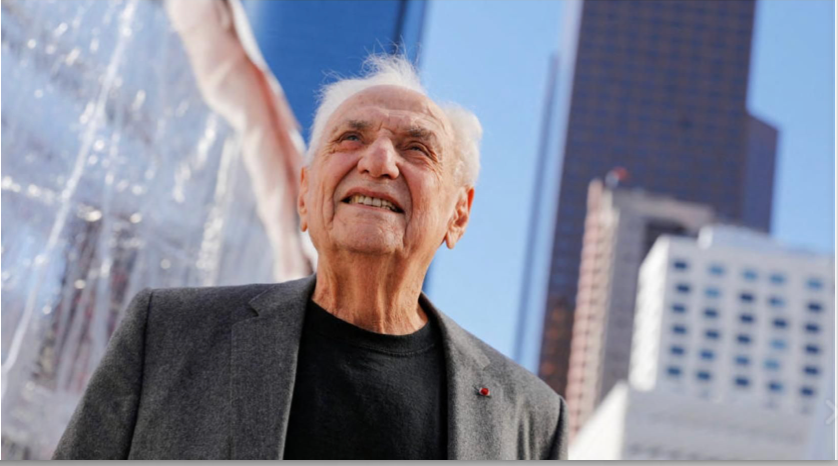
Crumpled titanium, billowing metal sails, buildings that seemed to twist and dance: Frank Gehry’s architecture never sat quietly. Like their creator, his buildings demanded attention, provoked argument, and refused to behave. Described as a ‘Titan of Architecture’, Frank was one of the very few architects whose name entered popular culture, referenced on The Simpsons as well as in architectural theory seminars. The controversial architect spent a lifetime tearing holes in convention and, in doing so, reshaped the trajectory of late-20th- and early-21st-century architecture.
Born Frank Owen Goldberg in Toronto in 1929 to Jewish parents of Polish descent, the Canadian-American architect’s early life was defined by movement, curiosity, and creative exploration. At a young age, his mother introduced him to classical musical concerts at Toronto’s Massey Hall, as well as the city’s art gallery, sparking a lifelong passion for painting, sculpture and music. Hours spent with his grandmother – playing with pieces of wood to build cities, bridges, and streets – instilled in him a love of making and designing from imagination, while his orthodox grandfather taught him to question everything: “Why? Why not? Why can’t I?” In his late teens, Frank’s family relocated to Los Angeles, a city that would encourage his artistic development. He went on to study architecture at USC and later at Harvard’s Graduate School of Design in the mid-1950s.
While Modernism still preached clarity and restraint, Frank gravitated towards disorder, improvisation and intuition. For years, that instinct had him hovering on the edges of acceptance, with early projects such as the Danziger Studio and Residence in Hollywood (1965) hinting at a restless, unconventional mind. Yet, mainstream recognition was slow to arrive. His work was often dismissed as unruly, impractical, or wilfully ugly. The label of deconstructivism followed him, though Frank himself was sceptical of theory-heavy categorisation. What mattered more to him was emotion – how a building felt, how it shaped human experience from the inside out.

That philosophy found its first explosive expression not in a major public commission, but at home. The Gehry Residence, begun in 1978, was far from a mere personal experiment; it functioned as both a manifesto and a launching pad for Frank’s emergence as a major architectural figure. Conceived as a renovation of his own modest Santa Monica house, the project was to test ideas free from the constraints of a conventional client or public expectation. Rather than demolishing the existing Dutch colonial structure, Frank wrapped it in a collage of chain-link fencing, corrugated metal, plywood, and exposed framing.
The house did not disguise its processes or materials; instead, it foregrounded them, transforming a familiar suburban typology into a site of architectural inquiry while challenging entrenched notions of finish, harmony, and domestic propriety. The result looked unfinished, even aggressive – more of a construction site than a dream home. Neighbours complained; critics scoffed. Yet, the Gehry Residence is now regarded as one of the most important houses of the 20th century, a manifesto in built form that announced Frank’s rejection of architectural politeness.
The Santa Monica house also foreshadowed a career-long fascination with exposing structure and process, grounded in Frank’s consistent prioritisation of internal function over external form. While the building’s fractured envelope and raw materials appear deliberately confrontational, this visual disorder masks a carefully considered spatial logic shaped by everyday use and lived experience. Frank repeatedly returned to the belief that architecture should begin not with the façade, but with the interior conditions that shape how people inhabit a space. As he later explained, “I design from the inside out… I think it’s important to create spaces that people like to be in, that are humanistic.”
In this light, the house’s apparent instability gives way to a quieter concern for durability, functionality, and the psychological comfort of its occupants. Exposed structure and unfinished surfaces do not signal neglect, but an insistence that construction and use remain visible and honest. The Santa Monica house thus becomes a testing ground for an approach that places human wellbeing at the centre of design, even when the resulting form resists conventional ideas of completeness. In this small yet radical project, Frank established an architectural language rooted in fragmentation, contradiction, and deliberate incompleteness – one that would later be scaled up without abandoning its humanistic core.
In 1989, at age 60, Frank was awarded the Pritzker Architecture Prize – often referred to as the ‘Nobel’ of the architecture world – in recognition of his highly refined, adventurous, and sometimes provocative approach. Frank was praised for his restless spirit and the way his work consistently expressed contemporary society, blending innovation with human-centred design. By the early 1990s, cities around the world were beginning to take notice.
The Olympic Games and a museum masterpiece
How the 1990s launched Frank Gehry into superstardom
Burdened by industrial decay, crumbling infrastructure, and a seafront cut off by rail yards and warehouses, Barcelona saw the 1992 Olympics as an opportunity for radical invention. Frank was commissioned to create a landmark for the revitalised waterfront, for which he drew inspiration from Catalonia’s maritime culture to design a monumental fish sculpture, a form both dynamic and organic, as if poised to leap into the Mediterranean. El Peix d’Or (1992) was groundbreaking for Gehry on multiple fronts: it was his first project to make extensive use of computer-aided design, enabling the creation of the sculpture’s complex curves and intricate geometry, and it marked his first work fully inspired by natural forms.

The result was a gleaming, 56-metre-long, 35-metre-high fish-like sculpture of intertwining golden stainless-steel strips. Its shimmering surface reflects sunlight and shifts with the weather, creating the illusion of scales in motion. Positioned at the foot of the luxurious Hotel Arts and overlooking the newly built Olympic Marina, the fish instantly became a focal point, linking leisure, luxury, and the sea. At the time, it was part of a bold gamble to transform a formerly industrial port into a glamorous civic space; today, it is impossible to imagine Barcelona’s seafront without it.
That gamble foreshadowed an even more dramatic reshaping of urban architecture; in 1997, the Guggenheim Museum Bilbao opened its doors, and architecture was never quite the same again. Clad in rippling titanium, limestone, and glass, the building appeared almost alive. Frank’s design seemed to defy gravity, folding and twisting in ways that felt sculptural. Inside the museum walls, three levels spiral around a vast atrium, linked by curved walkways, glass and titanium elevators, and staircases that guided visitors through a fluid, almost cinematic experience.
The museum became art itself, providing a backdrop that shifted and changed with the light. While many members of the public hailed the museum as a masterpiece, others were sceptical, even hostile. “When Bilbao was presented publicly, there was a candlelight vigil against me,” Frank said. “There was even a thing in a Spanish paper saying, ‘Kill the American Architect’. That was scary.” However, within a few years, Bilbao had been transformed. Once struggling, the Spanish city thrived, tourism surged, and the term ‘the Bilbao effect’ became part of the architectural dictionary to symbolise a building’s power to redefine a city.
Cities around the world rushed to replicate the formula, commissioning headline-grabbing cultural buildings in the hope of similar economic salvation. Frank was uneasy with the mythology and said, “It’s not new that architecture can profoundly affect a place. Architecture and any art can transform a person, even save someone.” Yet, even he could not deny that Bilbao marked his transition from celebrated architect to cultural phenomenon. The building’s impact was so widespread it became fodder for parody, including a 2005 episode of The Simpsons in which Frank – voicing himself – designs a concert hall inspired by a crumpled piece of paper. Three decades later, the Guggenheim remains Frank’s most celebrated work.
Technological innovation and stepping into the 21st century
Behind the apparent irregularity of his forms lay a quiet technological revolution, as Frank became one of the first architects to fully embrace advanced three-dimensional modelling software adapted from aerospace engineering, enabling his sketches and physical models to be translated into buildable realities. At a moment when such tools were widely regarded as prohibitively complex and expensive, he employed them to push architecture into new territory, ensuring that buildings which appeared spontaneous were in fact engineered with extraordinary precision.

The Walt Disney Concert Hall in Los Angeles (2003) epitomised this tension, with its sweeping steel forms initially derided as a ‘pile of broken crockery’ and an ‘emptied waste basket.’ Frank’s response was characteristically blunt: “At least they’re looking!” In a similar moment, he once gave a journalist the middle finger at a 2014 press conference in Spain after being asked if his ‘spectacular’ buildings were just ‘showy’, a question he felt dismissed the seriousness of his work; he later apologised, blaming jet lag and being caught at a bad moment. Over time, the building came to be celebrated for its acoustics and generosity as a public space as well as for its unique looks. Elsewhere, his unpredictability became his signature. Prague’s Dancing House (1996) appears to lean and sway mid-step; the Dr Chau Chak Wing Building in Sydney (2015) resembles a crumpled brown paper bag rendered in brick; his Hotel Marqués de Riscal in Spain (2006) erupts in ribbons of coloured metal. No two Gehry buildings look alike, united only by their refusal to sit still.
Even in his later years, Frank continued to take on ambitious projects. At 91, he completed the Dwight D. Eisenhower Memorial in Washington, D.C. (2020), a markedly restrained work that balanced public sensitivity, historical nuance, and storytelling. Despite being widely associated with expressive, sculptural architecture characterised by bold forms and an overt visual presence, Frank designed the civic monument in a way that worked against both his own architectural norms and the broader expectations of monumental memorial architecture most deliberately. Rather than relying on verticality, singularity, and symmetry to convey dominance, Frank opted to layer sculptures of Eisenhower at different stages of life with a stainless-steel tapestry of the Normandy coastline, set within a landscape-like composition, delivering a memorial that honoured both the man and wider American history without any flamboyance.
Significantly, Frank intentionally adopted a far more minimalist approach to challenge convention, representing Eisenhower not through heroic exaggeration but through a nuanced narrative that nodded to his service accomplishments, leadership, and general humility. This is further reinforced by the memorial’s very positioning as it sits close by three government departments the 34th U.S. president created – education, health, and the Federal Aviation Administration. As highlighted by The Guardian, Frank has “declared an end to the age of bombastic ‘great man’ monuments”, instead curating space for personal reflection and interpretation. Rather than seeking to capture immediate attention, the Dwight D. Eisenhower Memorial demonstrates that architectural significance can be achieved through restraint rather than excess.
Beyond architecture, Frank’s influence stretched across culture. Artists, musicians, and actors admired his work – including Brad Pitt, who spent time at Gehry’s Los Angeles office learning computer-aided design, more out of curiosity than ambition. It was a fitting reflection of Frank himself: his work spoke to anyone drawn to creativity without safety nets. Frank never sought classical elegance; he sought vitality, movement, and feeling. His buildings were not always comfortable or polite – but they were unforgettable. In a world that often prizes efficiency over imagination, he insisted on risk. Even after the titanium fades and the debates settle, his architecture will continue to do what he believed it should: make us stop, look, and feel.
His legacy encompasses a body of work that transformed architecture with daring inventiveness, producing buildings that were at once practical and profoundly expressive, inspiring generations of architects to challenge convention. While Los Angeles remained his home and anchor, his creations now span the globe, instantly recognisable for their energy and imagination. Even in his final years, Frank remained committed to shaping ambitious projects around the world, his vision continuing to guide developments from Los Angeles to Abu Dhabi, and even as he passed at 96, the studio he built on decades of collaboration and experimentation will carry his ideas forward, with projects like the Wimbledon Concert Hall, where the Trust and local council remain devoted to realising the architect’s bold vision.
Reflecting on his career, Frank once said, “It’s not new that architecture can profoundly affect a place, sometimes transform it. Architecture and any art can transform a person, even save someone.” That belief – woven into every curve and twist of his buildings – defines the legacy he leaves: a world forever changed by architecture that moves, provokes, and touches us deeply.


Comments